
What actually makes a website load fast, and why Google and customers both care
Website speed sounds like a technical detail until you learn what a slow site quietly costs you. Google crawls a fast site more thoroughly and ranks it more kindly, AI tools skip pages that take too long to load, and the customer on their phone leaves before your homepage has finished appearing. This article explains, without jargon, what actually makes a website fast, why modern build methods matter, and how to tell whether your current site is holding you back.
The three ways a slow site costs you
Customers leave. Most of your visitors are on a phone, often on patchy mobile data, and their patience is thin. A page that takes too long to appear loses people before they read a word, and you never see the enquiry that did not happen. On a service or shop site, speed is not a nicety, it is the difference between a visit and a bounce.
Google ranks you lower. Google measures real-world speed as part of how it ranks pages, through a set of signals called Core Web Vitals. A slow site is not just annoying to visitors, it is a ranking handicap, and Google crawls a fast site more thoroughly than a slow one.
AI leaves you out. The AI tools people increasingly use to find businesses, from Google's AI Mode to ChatGPT, favour pages they can fetch and read quickly and cleanly. A slow, heavy site is more likely to be skipped, which means less chance of being the business the AI reads and recommends. We covered that shift in our guide to the 2026 search changes.
“Fast websites are not just a technical consideration, they make the difference as to whether or not a real visitor is able to phone you or complete that form before they get bored, give up, and leave. It used to cost a lot to optimise a website so it was exceptionally fast, but we have developed a system that does this by default, as well as looking great.”
— Carrie Sargent, Coffee Marketing
What "fast" actually means: Core Web Vitals
Google puts a number on speed through three measures it calls Core Web Vitals. In plain English, they are:
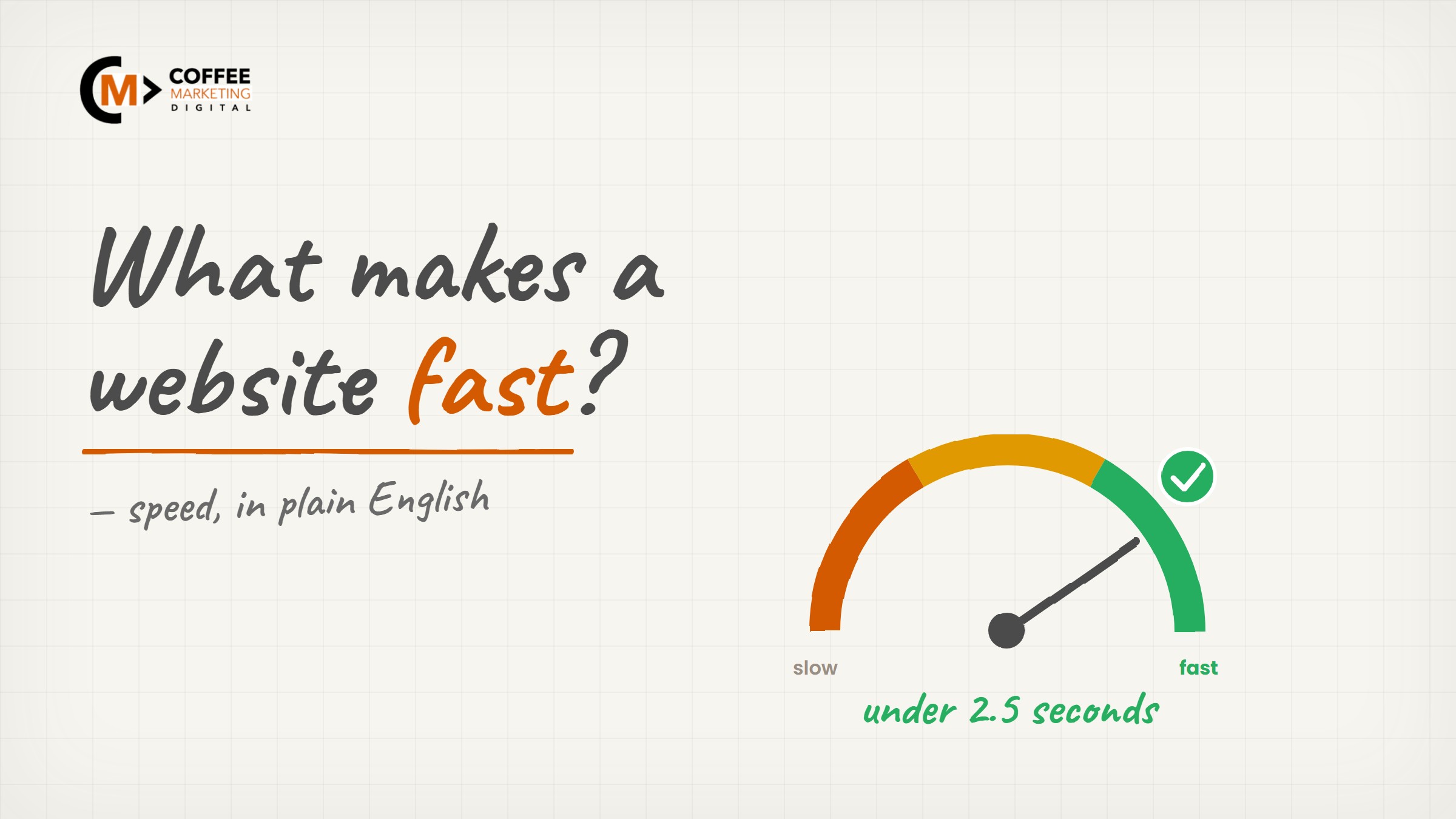
- Loading (LCP). How quickly the main content of the page appears. Google's target is under 2.5 seconds.
- Responsiveness (INP). How quickly the page reacts when someone taps or clicks. Google's target is under 200 milliseconds.
- Visual stability (CLS). Whether things jump around as the page loads, the thing that makes you tap the wrong button. Google's target is a score under 0.1.
These are the real measures Google publishes and uses, and you can read the detail on Google's own Core Web Vitals page. A genuinely fast site nails all three. A cheap or bloated one usually fails at least one.
What actually makes a site fast, or slow
Most slow sites are slow for the same handful of reasons, and none of them are mysterious.
- Heavy images. The single most common culprit. A photo saved straight off a phone or camera can be several megabytes, and a page full of them crawls. Proper sites resize and compress images so they look sharp and load light.
- How the site is built. A site running on a heavy platform stacked with plugins has a lot of code to load and run before anything appears. A lean, modern build has far less standing between the visitor and the page.
- Too much clutter. Every extra tracker, widget, font and third-party script adds weight. Speed is often about what you leave out.
- Where it is hosted. Slow hosting, or serving every visitor from a single distant server, adds delay that no amount of tidy code can hide.
- Not built mobile-first. A site designed for a big desktop screen and squeezed onto a phone tends to load far more than the phone needs.
Why we build on modern static-site technology
The sites we build use modern static-site technology, which is a large part of why they are fast. In plain terms, the pages are built in advance and served ready-made, rather than assembled from scratch on every visit the way a heavy plugin-driven site is. There is less to load, fewer moving parts to break, and it is naturally quick and secure. Before any site we build goes live, we quality-check it against Google's own Lighthouse speed scores, so speed is proven, not assumed.
How to tell if your current site is holding you back
You do not need to guess. Google's free PageSpeed Insights tool will test any page and score it against those Core Web Vitals, on mobile and desktop. Run your homepage and your most important pages through it.
The everyday signs are just as telling: your site feels slow when you open it on your phone away from the office wifi, elements jump around as it loads, or people click through from an ad or a listing and leave without doing anything. If that sounds familiar, the fix depends on the cause. Often a Technical Audit pinpoints exactly what is slowing the site and what to change. Sometimes the platform itself is the ceiling, and the honest answer is a rebuild on something faster.
What we do, and why it works
We design, build and look after fast websites for small businesses, and keep them that way. You get a site that loads quickly on a phone, ranks and reads well for Google and AI, and does the selling for you, without any of the technical upkeep landing on your desk.
What you get is a site built to perform:
- Fast and mobile-first by design. Modern static-site build, light images, and no plugin bloat, quality-checked against Google's Lighthouse scores before it goes live.
- Bespoke to your brand, not a template. A look built around your business, not a stock theme shared with a hundred competitors.
- Built to be found by Google and AI. The speed, structure and data that let both find and recommend you.
- Legally compliant from day one. The privacy, cookie and data-protection pages you are required to have in the UK.
- Fully managed and yours to keep. Hosting, security and updates handled on one simple monthly plan, on a site you own and can take anywhere.
Our Website Design & Build service starts from £350 to build, then from £49 a month to host and care for it. Already have a site that feels slow? A Technical Audit (£400) finds exactly what is holding it back and what to do about it.
Right now this is built for service and local businesses, and we are building an ecommerce version too, so if you sell online it is well worth an early conversation. If you are not sure whether your site is fast enough, the honest first step is a short chat. That is a free call, not a commitment.
Frequently asked questions
What counts as a good load time?
As a rule of thumb, the main content should appear in under 2.5 seconds and the page should feel instant to tap on a phone. Google's Core Web Vitals put exact targets on it, and a well-built site meets all three.
My site looks fine to me. Isn't that enough?
Not necessarily. Your own browser has the site cached, so it loads faster for you than for a first-time visitor on mobile data. Always test on a phone away from your office wifi, or use PageSpeed Insights, to see what customers actually experience.
Can a slow site be fixed without a full rebuild?
Often, yes. Heavy images, excess plugins and poor hosting can usually be fixed, and a Technical Audit will tell you exactly what to change. Sometimes the platform the site is built on is the real limit, and a rebuild on faster technology is the better long-term answer.