Intelligence Reports
AI Visibility Audit. Are you in the AI's answer?
A ten-dimension audit that measures, for one eCommerce brand, exactly where it stands on the technical and content signals that determine whether Google AI Mode, AI Overviews, Perplexity, ChatGPT and Microsoft Copilot will cite it. One headline AI Readiness Score, a per-dimension breakdown, and a 90-day action plan with published costs.
Who this is for
Built for eCommerce brands that need to know whether AI is naming them — or naming a competitor.
Organic traffic slipping
Brands seeing organic traffic plateau or decline as more product research happens inside AI assistants.
New to AI referrers
eCommerce teams that have never explicitly considered Google AI Mode, AI Overviews, ChatGPT, Perplexity or Copilot as referrers.
Want a measurable baseline
Brands with strong content suspecting they should be cited more often by AI search but aren't — and want a measurable baseline before they invest.
Concrete outputs. Built from data captured on the day.
Every figure in the deliverable comes from live measurement against the brand's actual site, feed and target prompts during this audit run. Dimensions that cannot be measured are excluded from the deliverable — never estimated, never fabricated.
AI Readiness Score (0–100)
A single headline score with letter grade and a per-dimension breakdown. Each dimension carries a weighted contribution to the overall number so the highest-impact fixes are obvious.
AI bot access check
Live fetch of robots.txt, llms.txt and the sitemap. Whether GPTBot, Google-Extended, ClaudeBot, PerplexityBot, OAI-SearchBot, Bytespider and CCBot can read the catalogue. Captured verbatim and stored as evidence.
Schema markup audit
Sampled product pages parsed for JSON-LD. Coverage of name, image, offer, brand, GTIN, SKU, MPN, aggregateRating, hasMerchantReturnPolicy and shippingDetails — the AI-critical fields.
Merchant Center feed quality + the 6 Conversational Attributes
Per-field coverage of GTIN, brand, MPN, product_type, shipping, returns and image fields. Plus the 6 Conversational Attributes defined in Google Merchant Center Help article 17085370 — question_and_answer, document_link, related_product, item_group_title, variant_option and popularity_rank.
Schema↔Feed consistency
Up to 20 sampled products cross-checked between the live product page and the Merchant Center feed for price, availability, brand, GTIN, SKU and title agreement. Divergence is a documented ranking penalty. The deliverable lists the actual products inspected with their URLs.
Passage-level content quality (MUVERA-aware)
Top pages scored at the passage level on direct-answer-block presence, fact density, structured formatting and entity matching — the signals Google's new ranking architecture measures.
Query fan-out coverage
Each target prompt decomposed into the 8–12 sub-queries AI Mode is likely to generate, then matched against the brand's existing pages to identify content coverage gaps.
Live citation testing on five AI surfaces
The same target prompts run through Google AI Mode, Google AI Overviews, Perplexity, ChatGPT and Microsoft Copilot. Per-surface citation rate, competitor share-of-voice and which prompts cited which competitor.
Agentic commerce readiness
Ten technical checks for Universal Cart, Agent Payments Protocol (AP2) and Google's UCP — machine-readable product endpoint, guest checkout, processor compatibility, anti-bot friction, schema completeness, price/stock stability.
90-day action plan with published costs
A prioritised Days 1–30 / 31–60 / 61–90 plan ordered by weighted contribution to the AI Readiness Score. Each remediation is paired with the recommended Coffee Marketing service and its catalogue price — no hourly rates, no surprises.
Branded PDF + raw evidence pack
A Coffee Marketing-branded PDF (typically 15–25 pages) plus the underlying evidence pack — screenshots, captured robots.txt and llms.txt, sitemap summary, per-dimension JSON files. Yours to brief content, dev and SEO with.
From invisible to cited — with a plan to get there.
The brand stops being invisible to the conversations that matter. When a prospect asks an AI 'what's the best [product]?', the brand shows up — with the right context, the right link and the right price.
The downstream effect: a slow but compounding new traffic source as AI search moves from novel to default for product research, and a defensible position when agentic shopping arrives.
From kickoff to branded PDF in five working days.
Brief & target prompts
20-minute call to confirm the brand, primary domain, competitors and the target prompts that matter. If target prompts are absent, they are auto-generated from the product feed across four canonical categories (brand, category, comparison, problem-solving).
Foundations sub-audits
Bot access, schema markup, Merchant Center feed quality and Conversational Attributes, schema↔feed consistency and agentic commerce readiness — all measured in parallel against live site data and the actual feed file.
Content & fan-out analysis
Top pages scored at the passage level. Target prompts decomposed into sub-queries via Gemini, then matched against existing content to surface coverage gaps.
Live citation testing
Target prompts run through Google AI Mode, AI Overviews, Perplexity, ChatGPT and Microsoft Copilot. Per-surface citation rate, competitor share-of-voice and the actual answers captured for evidence.
Score, evidence, deliverable
The AI Readiness Score is aggregated across assessed dimensions; evidence (screenshots, robots.txt, llms.txt, sitemap, raw JSON) is captured into the client folder; the branded PDF is generated plus a 30-minute walk-through call.
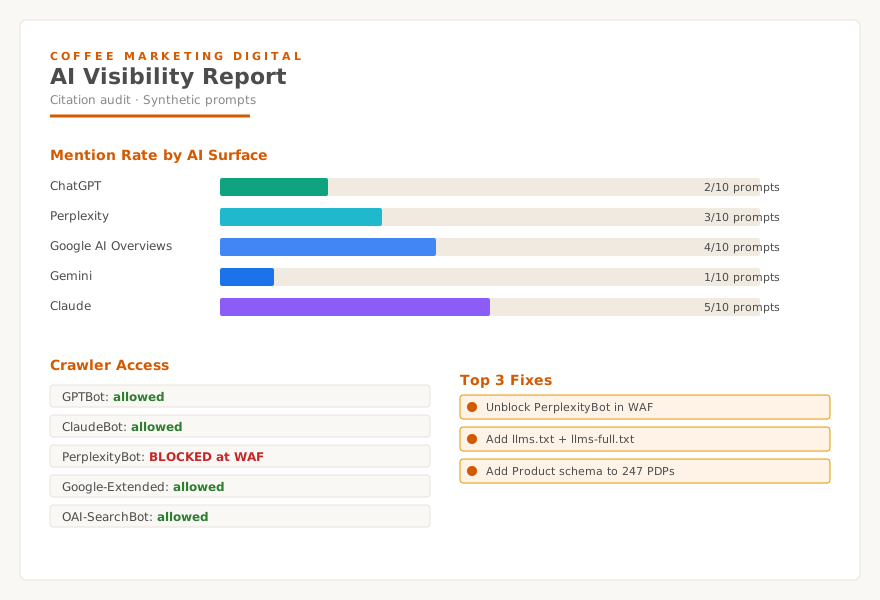
An anonymised example of the deliverable.
A representative shape of the branded PDF — headline AI Readiness Score, per-dimension table with weighted contribution, sampled schema↔feed consistency rows with product titles and URLs, and the prioritised 90-day plan with catalogue-priced services.
The example uses synthetic identifiers; every figure in a real audit comes from live measurement.
Indicative price. Final quote tailored.
A single fixed price for every business is not realistic — what's straightforward for one client is complex for another. The figure below is the floor; the final quote depends on the variables underneath it.
From £150 report · from £450 implemented
Quick depth (5 prompts, AI Mode + AI Overviews, top 5 pages) starts at £150. Standard is £300 and Deep is £600, extending the prompts, surfaces and pages sampled. Every audit produces the same ten-dimension AI Readiness Score, branded PDF and 90-day plan — depth determines how much live testing sits underneath. Implementing the fixes is a separate engagement from £450.
What changes the final price
- Depth tier: Quick (£150), Standard (£300, recommended) or Deep (£600) with all five surfaces — each tier scales prompts, pages sampled and live citation testing.
- Catalogue size: a 200-SKU site audits faster than a 50,000-page eCommerce catalogue (more PDPs to sample, larger feed to parse).
- Existing schema and feed state: if the brand already has rich Product schema and a complete feed, the schema and consistency portions are faster.
- Custom target prompts: brands wanting deeper category coverage book extra prompts at a per-prompt rate.
- Implementation: not included — recommended fixes carry catalogue prices in the 90-day plan and can be commissioned separately or bundled with a retainer.
Maturity stage
Best aligned to all stages of the Digital Marketing Maturity Model.
A baseline audit benefits brands at every DMMM stage — early-stage brands get a measurable starting line; mature brands get a defensible position before agentic commerce arrives. Scoped to fit, never obligatory.
The questions businesses actually ask.
Does this actually drive traffic? AI assistants don't always link.
Some surfaces link reliably (Perplexity, Google AI Overviews); others link variably (ChatGPT). Both still matter — being in the answer drives brand recall even when the citation does not become a click. The audit measures citation presence per surface; click-through from AI surfaces is measured separately under analytics if the brand has GA4 wired up.
Are the figures real, or estimated?
Real. Every score in the deliverable comes from live measurement during the audit run — robots.txt and llms.txt fetched on the day, sampled PDP schema parsed live, the actual feed parsed for coverage, target prompts run through the AI surfaces and the resulting citations recorded. Dimensions that cannot be measured (for example because the relevant access is unavailable) are excluded from the score rather than estimated.
What's the difference between Quick, Standard and Deep?
Quick is 5 prompts on AI Mode + AI Overviews with the top 5 pages scored. Standard adds Perplexity and extends to 15 prompts and top 10 pages — the recommended tier for first audits. Deep extends to 30 prompts across all five AI surfaces (including ChatGPT and Copilot) and scores the top 20 pages. The same ten-dimension framework runs in all three; only the live-testing breadth changes.
What are the 6 Conversational Attributes?
They are the optional Merchant Center attributes Google defines specifically to help AI surfaces recommend products in conversational queries: question_and_answer, document_link, related_product, item_group_title, variant_option and popularity_rank. Source: Google Merchant Center Help article 17085370. The audit measures coverage of each, identifies the gaps, and the 90-day plan includes building a supplemental feed to populate them.
Will the fixes be implemented?
Implementation is quoted separately — the 90-day plan carries published catalogue prices for each recommended fix (schema implementation, llms.txt deployment, supplemental feed build, content rewrites). Some brands implement in-house once the plan is in hand; others bundle the work into a retainer.
How often should this be re-run?
Quarterly is the right cadence — AI surfaces and the ranking signals beneath them change rapidly, and competitors who fix their foundations close the gap quickly. Brands in active optimisation re-run monthly to track citation trends.
Is this just SEO with a new name?
No. Traditional SEO optimises for ranking on Google's blue links. The AI Visibility Audit optimises for being chosen, quoted and (in the agentic-commerce future) purchased from inside an AI answer. Different surfaces, different signals, partly overlapping but mostly distinct.
Each dimension is weighted by its impact on AI visibility.
The score is the weighted sum of ten dimensions.
| Feature | What it measures | Weight |
|---|---|---|
| AI Bot Access | Whether AI crawlers can read the catalogue; presence of llms.txt; sitemap freshness. | 5% |
| Schema Markup | Coverage of Product, Offer, ShippingDetails, MerchantReturnPolicy, identifiers, ratings across sampled PDPs. | 10% |
| Feed Quality + Conversational Attributes | Primary feed field coverage plus the 6 Conversational Attributes (GMC Help article 17085370). | 15% |
| Schema↔Feed Consistency | Per-product agreement between live PDP schema and feed values across six checks. | 5% |
| Content Quality (passage-level) | MUVERA-aware passage scoring: direct-answer blocks, fact density, structured formatting. | 15% |
| Fan-Out Coverage | Whether the brand has content that wins each of the 8–12 sub-queries every target prompt generates. | 10% |
| AI Mode Visibility | Live test: in how many target prompts does Google AI Mode cite this brand. | 15% |
| AI Overviews Visibility | Same measurement against Google's AI Overviews layer (separate citation overlap). | 5% |
| Third-party AI Surfaces | Mean citation rate across Perplexity, ChatGPT and Microsoft Copilot. | 10% |
| Agentic Commerce Readiness | Ten technical checks for Universal Cart / AP2 / UCP buyability by AI shopping agents. | 10% |
Pick the scope that matches the stakes.
Every report records the depth it was produced from.
| Feature | Prompts tested | AI surfaces | Pages sampled | Turnaround |
|---|---|---|---|---|
| Quick | 5 | AI Mode + AI Overviews | Top 5 | ~3 days |
| Standard (recommended) | 15 | AI Mode + AI Overviews + Perplexity | Top 10 | ~5 days |
| Deep | 30 | All 5 surfaces incl. ChatGPT + Copilot | Top 20 | ~7 days |
Google Partner
Certified across Search, Shopping and Performance Max.
Microsoft Advertising Partner
Deep UET and Microsoft Ads specialism.
UK-based · Bournemouth
A real UK team you can talk to, not an offshore desk.
GDPR & UK ICO compliant
Consent Mode v2 and ICO guidance built into every audit.
Not sure whether an AI visibility audit is what you need yet?
Take the free Digital Marketing Maturity assessment and see exactly where AI visibility sits among your priorities — no commitment, results in minutes.
Platforms we monitor and optimise.

Are you in the AI's answer?
Tell us your brand, your category and the competitors you want to be measured against. We'll come back with a scope, a fixed report price, and an honest read on which depth tier fits.
One conversation. A clear plan. No obligation.
Privacy Policy: We won't (ever) share, use, sell or do anything with this information other than for the purpose of this initial project or reasons you agree to in future.