
Shopify Campaign Autopilot: What UK Retailers Should Know
Shopify Campaign Autopilot is a free AI marketing tool inside your Shopify admin. It plans and runs campaigns across Meta ads, Microsoft Advertising and email, and you decide whether it asks for your approval first or acts on its own. If you have had the early-access email, you can safely click through and look — just check that permissions setting before you connect a channel.
Last updated: 29 September 2026.
It is already reaching UK merchants: one of our clients has been offered early access for the Meta and email channels. So this is not a US-only story you can file away for later.
Two things have changed since we first wrote this, and both matter. First, Microsoft Advertising went live in Autopilot on 4 August 2026 — and that is the one to think carefully about if somebody already manages your Microsoft Ads account. Second, the approval step is now a setting, not a guarantee. Shopify lets you choose whether Autopilot creates email and ad campaigns on its own or waits for you.
What Campaign Autopilot actually is
Shopify announced it in June 2026. It sits under Growth > Autopilot in your admin, reads your products, customers and order history, and proposes marketing campaigns. You set a monthly budget and guardrails; it drafts the campaigns; and, if you have told it to ask first, each one lands in a Pending actions list waiting for your approval.
The tool itself is free on every Shopify plan except the Agentic plan. You pay the ad spend — Meta and Microsoft bill you directly, and that spend does not appear on your Shopify invoice.
To be eligible you need Shopify Payments switched on, at least one product, a store that is not in private mode, shipping set up, refund and shipping policies published, and a store that meets Shopify's account standing requirements. Your staff also need the Marketing permission. Shopify re-checks eligibility periodically and stops running campaigns if you fall out of it.
What we know so far: the channels
| Channel | Status | Available in the UK? |
|---|---|---|
| Meta Ads (Facebook, Instagram) | Live | Yes |
| Shopify Messaging (email automations) | Live | Yes |
| Microsoft Advertising | Live since 04/08/2026 — runs Performance Max campaigns | Not stated by Shopify |
| Shop Campaigns | Live | Shop Campaigns itself now accepts UK stores; Shopify has not yet confirmed Autopilot runs it for them |
| ChatGPT Ads | Coming soon, no date | Unknown |
| Snapchat | Coming soon, no date | Unknown |
Google Ads is still not on this list, and that is not an oversight on our part. We re-checked Shopify's product page, Help Centre and changelog on 29 September 2026. Google is not listed as live or as coming soon. You may see it reported otherwise — one widely-shared social post from a trade title tagged Google alongside Meta, but the article underneath it does not mention Google at all.
That said, Shopify already has a route into your Google Ads account and has had for years: the Google & YouTube sales channel, which creates Performance Max campaigns in the merchant's own account. If Shopify ever folds that into Autopilot, the plumbing is already installed. It is the thing we are watching most closely.
What it genuinely does well
We are not going to pretend this is a bad product. Three things stand out.
The controls are there — if you use them. You can make Autopilot ask before it creates any email or ad campaign, set guardrails, and pause it; pausing Autopilot pauses the Meta campaigns it created. Two things to know: the approval step is a setting you choose, not a default you can assume, and Shopify's own help page describes the monthly budget as a target that Autopilot can spend above because of delayed attribution. Set the permissions to ask first, and treat the budget as a guide rather than a ceiling.
It stays out of the way of what you already run. Autopilot's Meta campaigns use a separate ad account and product catalogue. They do not merge with, replace or edit an existing Facebook and Instagram setup. If you have a media buyer, their work is untouched.
Email is the honest win. Most small retailers have no abandoned-checkout sequence and no welcome series. Shopify's own product lead has said email is the channel merchants underuse most, and he is right. If you are running nothing, automated basket recovery will make you money. That part we would encourage.
“The tool is free and the ad spend is not, and those two facts get blurred in the marketing. Try the email automations — if you’re running nothing, basket recovery is the easiest money in retail. Just don’t let paid spend start flowing through a channel your reporting can’t see.”
— Carrie Sargent, Coffee Marketing
Where we would be cautious
None of what follows makes Autopilot a bad tool. It makes it a tool with a shape — and it is worth knowing the shape before you build on it.
The number you judge it by will move in the wrong direction
This is the one that concerns us most, and it has nothing to do with whether the ads are any good.
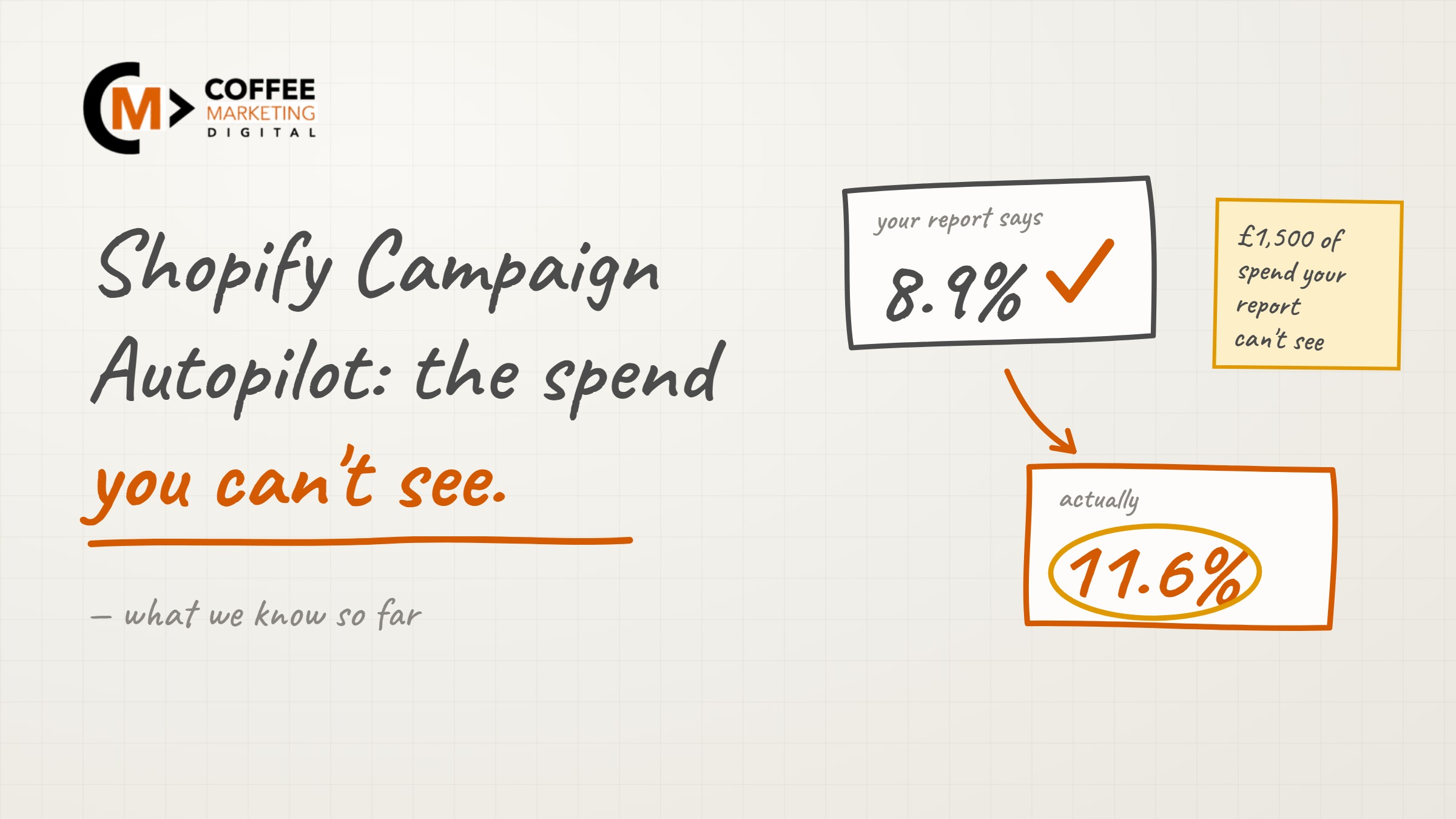
Autopilot spend does not appear in the reports you already use to judge your advertising — Meta and Microsoft bill it directly, and it is not on your Shopify invoice either. The revenue it generates does — it lands in your Shopify total like every other order. So your cost of sale improves on paper while your actual position gets worse.
Here is the arithmetic. These figures are illustrative, not a client result:
| Before Autopilot | Your report says | In reality | |
|---|---|---|---|
| Revenue | £50,000 | £56,000 | £56,000 |
| Ad spend counted | £5,000 | £5,000 | £6,500 |
| Cost of sale | 10.0% | 8.9% | 11.6% |
Your reporting says cost of sale improved by more than a point. It got worse by more than a point and a half. And at a 15% product margin, the picture underneath is this: gross profit rises from £7,500 to £8,400, but ad spend rises from £5,000 to £6,500. You have gone from £2,500 to £1,900.
Revenue is up £6,000 and you are £600 worse off.
We lead with cost of sale rather than ROAS for exactly this reason — it is the number that tells you whether the business is actually better off, and it only works if every pound of spend is inside it. Half a marketing budget sitting outside the report is not a reporting inconvenience. It is a decision you will get wrong. It is the same trap we pull apart in spend versus efficiency.
The fix is not complicated: whatever Autopilot spends each month has to be folded into the same number as everything else. But it has to be somebody's job, and by default it is nobody's.
The channel worth pausing on
Microsoft Advertising is now live in Autopilot. Autopilot can create a Microsoft Advertising account for you or connect to an existing one, then runs Performance Max campaigns and moves budget between channels automatically. If your Microsoft Ads account is actively managed, connecting it puts a second bidder into the same auctions, on the same products, funded by the same business.
You do not lose money because the AI is careless. You lose it because two bidders competing for the same click bid the price up between them. If somebody manages that account for you, this is a conversation to have before you connect the channel, not after.
It is the same pattern we flagged when Google started making in-account recommendations on your behalf — see the Google Ads Advisor risks. A platform optimising inside its own walls is not the same as somebody optimising for your business.
What the automation cannot see
Autopilot optimises against what it can measure, which is Shopify order data. That makes it strong at retargeting people who already know you, and it will report those conversions confidently — including the ones who would have come back anyway.
It also cannot see anything happening off-platform. Roughly half of some of our clients' sales happen over the phone or in a showroom. Autopilot has no visibility of that, so a product line that looks unprofitable on Shopify data alone may be doing the heavy lifting elsewhere. Two other practical limits worth knowing: it builds ads from your existing catalogue rather than generating new creative, so your photography caps the ceiling; and Shopify's own documentation warns that if you edit an Autopilot campaign directly in Meta, Autopilot may overwrite your changes.
This is the direction of travel across every platform, not just Shopify — we set out where we think the value moves next in manual bidding is dead.
If the email has landed in your inbox
Look at it. Click through. Set Permissions so Autopilot asks before it creates anything, and the email automations are worth a genuine trial.
Before you approve any paid spend, decide who is folding that spend into your cost of sale each month — and if anyone manages your Microsoft Ads, talk to them before you connect that channel.
One thing to do this week
Open your Shopify admin, go to Settings, and check whether the Google & YouTube channel is connected and whether anything is running through it. Most retailers we speak to do not know the answer. That channel can already create campaigns in your Google Ads account — and unlike Autopilot, it has been able to for years.
If you would rather someone kept an eye on the whole picture — every channel, in one number that tells you the truth — that is what our Digital Business Managers do. Our tracking audit is where most people start, because it answers the question this article is really about: is your reporting telling you what you think it is?