
Why your Google Ads numbers don't match your P&L, and the fix that starts to close the gap.
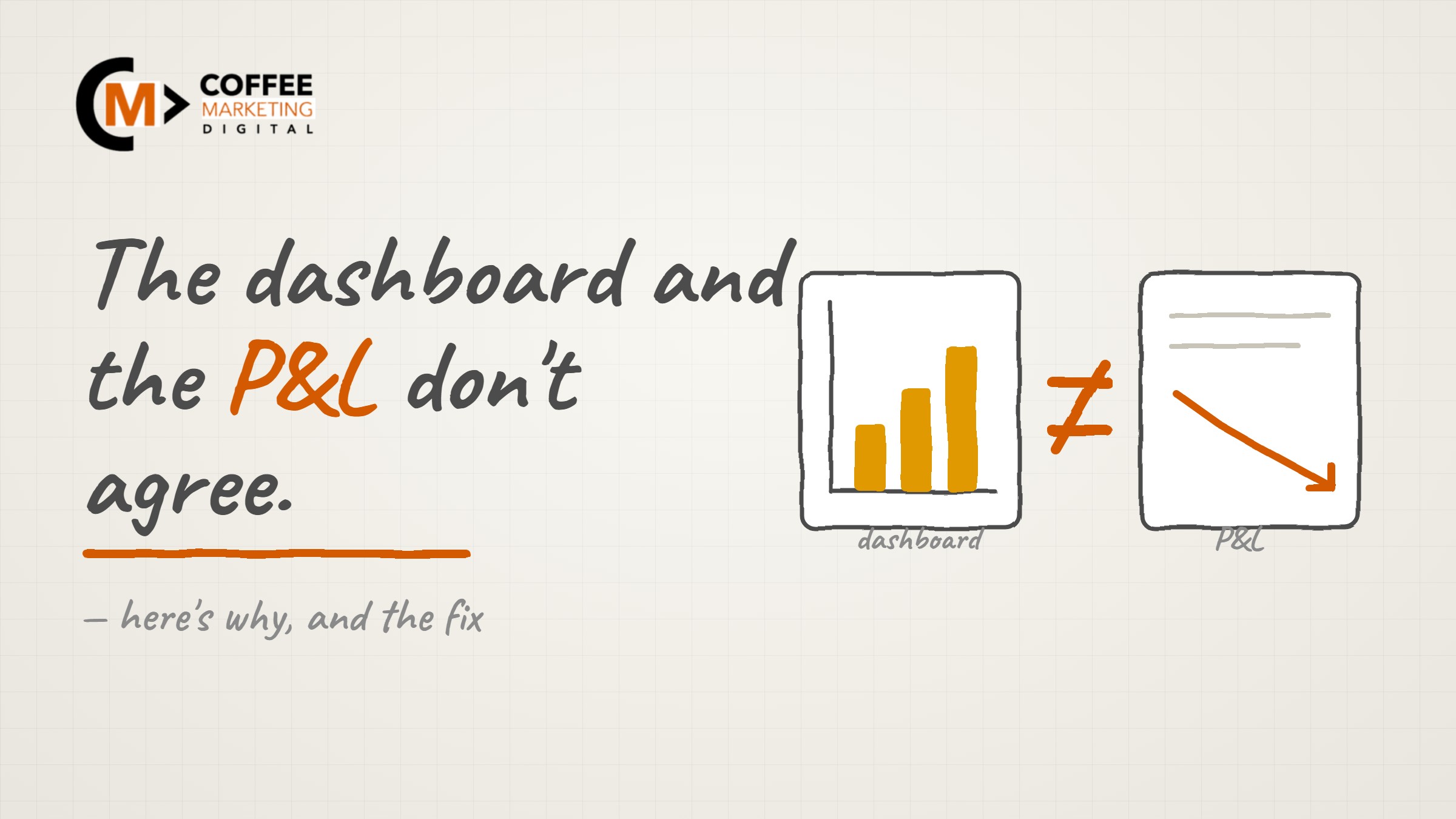
Ask a finance director whether they trust the marketing numbers and watch the pause. There is usually a good reason for it. In most ecommerce accounts every sale is reported to Google as if it were worth the same, a ten pound order and a hundred pound order pulling the platform in identical directions, with returns and refunds rarely making it back into the picture. This article explains why the ad dashboard and the P&L drift apart, and the practical first step that starts to bring them back together.
Why the dashboard and the P&L drift apart
Three things pull the two reports in different directions, and most accounts have all three.
Every conversion is treated as equal. By default, Google counts a sale as a sale. A £10 order and a £100 order send the platform the same signal, so smart bidding, doing exactly what you told it, happily buys more of the cheap, low-margin sales because they look identical to the valuable ones. The dashboard shows conversions going up. The P&L shows margin going down. Both are telling the truth.
Returns and refunds never come back. Revenue gets counted the instant someone checks out. The refund lands three weeks later, in a different system, and is almost never fed back into the ad account. So a category with a high return rate looks like a hero on the dashboard and a loss-maker in the accounts. You are optimising towards the products people send back, and the numbers cannot see it.
The platform takes credit generously. Ad platforms attribute conversions to themselves whenever they can, which is why the sum of every channel's reported sales is usually larger than the orders in your Shopify or CRM. Without reconciling against your actual back-end data, the dashboard overstates its own contribution, and the gap with the P&L widens.
None of this means the ads are failing or the platform is lying. It means the dashboard was built to count activity, and the P&L is built to count profit, and nobody joined them up.
Why this is a finance problem, not just a marketing one
The reason this matters beyond the marketing team is trust. When the ad dashboard says one thing and the management accounts say another, the finance team stops believing the marketing numbers, and marketing loses its seat at the table for the decisions that matter, budgets, headcount, investment.
Winning that trust back is not about prettier reports. It is about speaking the language finance already uses: margin, contribution, cost of sale. Cost of sale, your ad spend as a percentage of the revenue it drives, translates straight into a margin conversation a CFO recognises. Profit per order and contribution by product type turn a marketing dashboard into something a board can act on. When marketing reports in the same units as the P&L, the arguments stop being about whose numbers are right.
The 30-minute audit that starts closing the gap
You do not need a re-platform to make progress. Most of the gap comes from a handful of fixable things, and you can scope them in about half an hour.
- Check how conversions are valued. Are you sending Google the actual order value, or a flat number? If every conversion carries the same value, that is the first and biggest fix.
- Move towards profit-based conversion values. Feed the platform a value that reflects margin, not just revenue, so bidding optimises towards the sales you actually want more of. Even a simple margin banding by product type beats treating everything as equal.
- Get returns and refunds into the signal. Make sure refunded orders are removed or adjusted, so the account stops learning from sales that came back.
- Reconcile against your back end. Spot-check a week of Google's reported conversions against the orders in Shopify or your CRM. If they are wildly apart, you have an attribution or tracking problem worth fixing before you trust another decision to the dashboard.
Do those four, and you typically stop wasting the slice of budget, often in the region of ten to twenty percent, that was quietly chasing low-value and returned sales. More importantly, the dashboard starts to move in the same direction as the P&L.
The deeper fix: put profit at the centre
The audit closes the obvious gap. Keeping it closed means making profit, not revenue, the number your reporting is built around: margin in the feed, returns netted off, cost of sale by product type, profit per order on the dashboard. That is exactly what our Analyser is built to do, so the number on the wall is the one the finance team already trusts.
This is the measurement companion to a wider point we make in revenue looked great, profit told a different story: a healthy dashboard can sit on top of a shrinking business, and the fix starts with measuring the right thing.
What we do, and where to start
A Tracking Audit is the practical first step: we check how your conversions are valued, whether returns are handled, and how far the dashboard has drifted from your real orders, then give you the specific fixes in priority order. From there, the Analyser keeps profit and cost of sale at the centre of your reporting month to month.
The goal is simple: a marketing report the finance team believes, because it is measuring the same thing they are. If you want us to look at where yours has drifted, tell us the challenge.
Frequently asked questions
Why does Google report more sales than my Shopify shows?
Because ad platforms attribute conversions to themselves generously, and the totals across channels overlap and double-count. Reconciling Google's reported conversions against your actual back-end orders is how you find the real number.
What are profit-based conversion values?
Instead of telling Google every sale is worth the same, you send a value that reflects the margin on that sale, so bidding optimises towards profitable orders rather than just more orders. Even simple margin banding by product type is a big step up from flat values.
Isn't tracking returns complicated?
Getting it perfect can be, but getting it useful is not. The important first move is making sure refunded orders are removed or adjusted so the account stops learning from sales that came back. A tracking audit will tell you the cleanest way to do it for your setup.