
Digital Marketing Maturity Model: A Guide for eCommerce
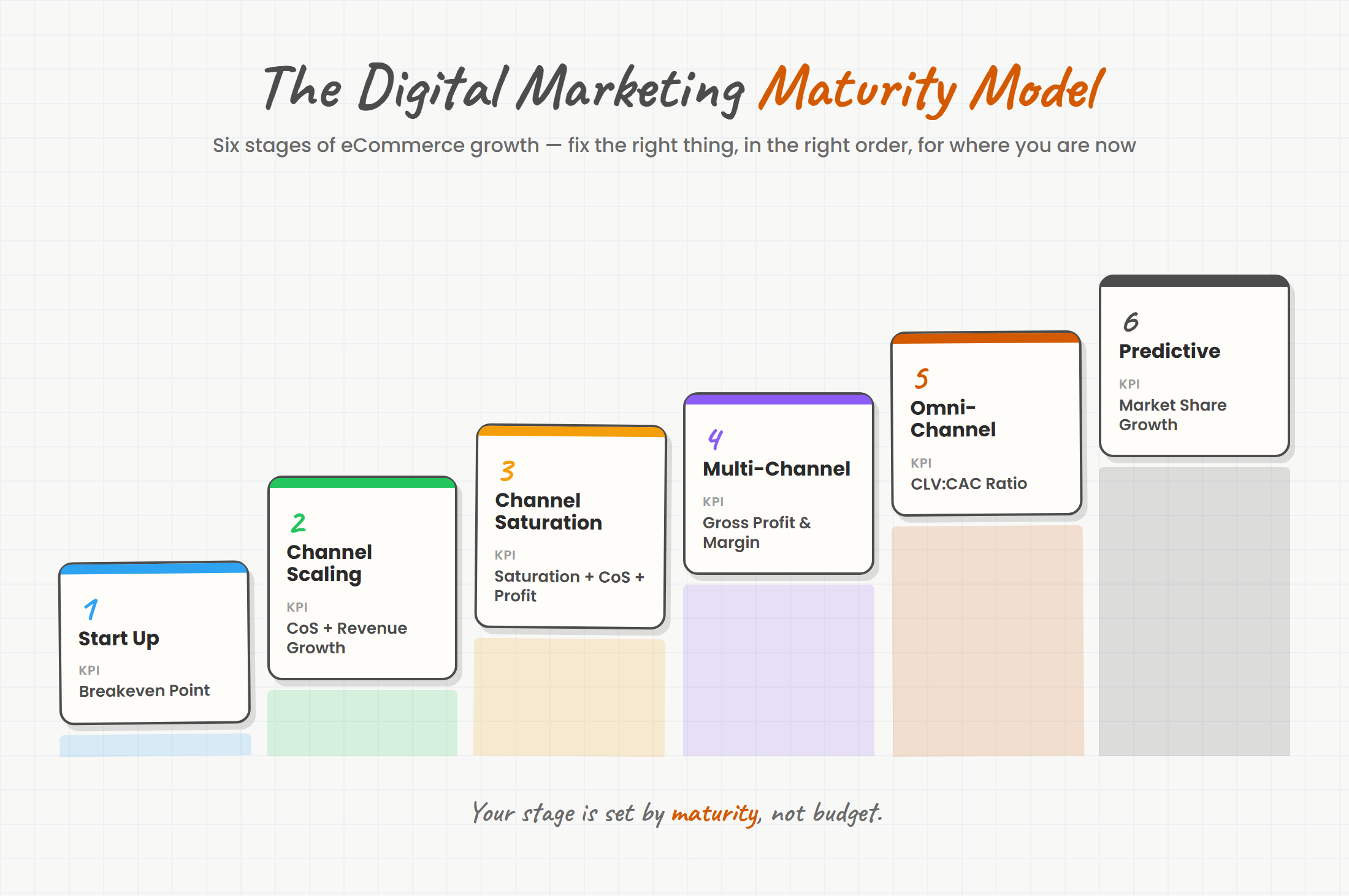
What is the Digital Marketing Maturity Model? The Digital Marketing Maturity Model (DMMM) is Coffee Marketing's proprietary six-stage framework that maps every interlocking factor of a digital business — from the ad account and product feed to checkout, creative, channel mix, and margin — and tells you which factor to fix, in what order, for the stage your business is at right now.
Most owners treat poor ad performance as an ad-account problem. It almost never is.
The return on every click is governed by the whole business behind it: the checkout, the product feed, the creative, the channel and timing mix, the pricing and the margin. A PPC specialist optimises the account and hopes the rest holds up. That works — until it stops. What actually produces better performance, consistently, is managing the whole picture.
That is what the Digital Marketing Maturity Model exists to do: give us a map of which interlocking factor to fix, in what order, depending on the stage your business is at right now.
Why the ad account is rarely the real problem
Here is the scenario we see often. Two businesses, similar products, similar budgets, almost identical Google Ads structures. One is profitable. One is not. On paper they look identical. ROAS of 4:1 each. Same click volume, similar CPCs.
The difference is everything outside the account.
Illustrative example — same ROAS, very different outcomes:
| Factor | Business A | Business B |
|---|---|---|
| Monthly ad spend | £30,000 | £30,000 |
| Revenue | £120,000 | £120,000 |
| ROAS | 4:1 | 4:1 |
| Gross margin | 55% (feed optimised; high-margin products promoted) | 38% (feed unoptimised; budget skewed to low-margin lines) |
| Mobile checkout conversion rate | 3.2% (no friction) | 1.4% (three-step payment, crashes on iOS 17) |
| Cost of Sale (ad spend ÷ revenue) | 25% | 25% |
| Gross profit after ad spend | £36,000 | £15,600 |
This is an illustrative example, not a reported client result. The numbers are constructed to make the principle concrete.
Both businesses have the same ROAS. Both spend the same amount. One is profitable. The other is burning cash. The ad account cannot see the margin problem. It cannot see the checkout failure. A PPC manager who reports "4:1 ROAS — all good" is telling the truth and missing everything that matters.
Cost of Sale (CoS) — advertising spend as a percentage of revenue — is the metric we lead with, because it keeps the relationship between spend and revenue visible. But as the example shows, CoS alone cannot tell you whether that revenue is profitable. You need the whole picture.
What the Digital Marketing Maturity Model actually is
The DMMM is Coffee Marketing's framework for mapping where a digital business stands today and what it needs to do next. It covers six stages of maturity, from the first proof of concept through to full market leadership at scale. At each stage, the model defines the right objectives, the right KPIs, the right channel mix, and the right order to tackle each factor.
The key word is order. Stage-appropriate action is what separates businesses that progress from those that plateau. A Stage 1 business spending money on multi-channel attribution tooling is solving the wrong problem at the wrong time. A Stage 3 business running a single Performance Max campaign has already hit the ceiling of that approach. The model tells you where you are — and therefore what to do next, instead of what a larger competitor does.
One clarification on spend ranges: the indicative monthly ad spend figures below are positioning guidance, not gates. Stage is determined by maturity and a completion checklist, not by budget alone. The bands overlap deliberately.
The six stages
Stage 1 — Start Up (£3k–£20k/month ad spend)
Primary focus: Proof of Concept. Primary KPI: Breakeven Point.
The goal at Stage 1 is to establish a commercially viable baseline. Can the business acquire customers profitably at all? We build the tracking, the feed, and the core campaigns (Google Performance Max and Search) needed to generate the first meaningful data. No business should be building advanced automation before it knows its breakeven point.
The most common mistake: skipping feed quality and tracking in the rush to go live. A strong product feed is the single biggest lever at Stage 1 — it determines where Shopping ads appear, which products get promoted, and whether the data you collect is reliable enough to optimise from.
Stage 2 — Channel Scaling (£20k–£50k/month ad spend)
Primary focus: Scaling Revenue. Primary KPIs: CoS + Revenue Growth.
At Stage 2, you have proof it works. Now the job is to scale efficiently. We add segmentation — own-brand campaigns, category campaigns, product-group splits — and start tracking CoS at campaign level. Search and Shopping structure matures. CSS partnership comes in here if it has not already (it makes bids 20% more competitive without spending more). SEO integration begins.
The most common mistake: scaling budget before CoS targets are locked in by product group. Budget added to an unsegmented campaign compounds existing inefficiencies.
Stage 3 — Channel Saturation (£40k–£80k/month ad spend)
Primary focus: Maximising Profit. Primary KPIs: Saturation signal + CoS + Profit.
Saturation is the inflection point. Search and Shopping are performing. The question becomes: have we captured all the available demand on these channels at a profitable CoS? We push toward that saturation point systematically — SKU-level campaign structure, Microsoft Ads added to capture Bing demand, promotional calendars aligned with commercial planning. Then we ask whether marginal budget returns incremental profit, or whether it just buys cheaper-converting searches.
The most common mistake: interpreting diminishing returns as a channel problem and pulling budget. It is often a signal to hold the channel and open a new one, not to retreat.
Stage 4 — Multi-Channel (£70k–£150k/month ad spend)
Primary focus: Profit Optimisation. Primary KPI: Gross Profit and Margin.
Stage 4 moves beyond search. The business has search and shopping working. The next growth comes from reaching new audiences earlier in the journey — paid social, video, display — built around a full-funnel strategy. Attribution becomes genuinely important here, because social investment looks poor in last-click reporting even when it is doing essential upper-funnel work. The KPI shifts to gross profit and margin, not revenue.
Stage 5 — Omni-Channel (£130k–£250k/month ad spend)
Primary focus: Total Business Impact. Primary KPI: CLV:CAC Ratio.
Stage 5 businesses operate across all relevant channels simultaneously, with fluid budgeting and continuous channel-mix testing. The question is no longer "which campaign performed?" but "what is the lifetime value of the customer this activity produced, and what did it cost to acquire them?" Marketing integrates with the commercial and operational parts of the business.
Stage 6 — Predictive (£250k+/month ad spend)
Primary focus: Market Leadership. Primary KPI: Market Share Growth.
At Stage 6, the business uses aggregated data and predictive modelling to manage demand generation across the full commercial operation. Marketing is woven into the core of the business — not a separate function sitting alongside it.
What good looks like — and how to find your stage
The DMMM is not about where you aspire to be. It is about where you actually are, so you fix the right thing first.
A business at Stage 1 that tries to run a Stage 4 full-funnel strategy will waste the budget and wonder why it failed. A business sitting at Stage 2 with an account-only PPC agency will hit the CoS ceiling and never understand why spend stops converting at the same rate.
Your stage is set by maturity and completeness — by whether the foundations at your current stage are genuinely solid, not by the size of your budget. The checklist for each stage covers the commercial, technical, structural and measurement factors that must hold before the next one begins to pay off.
From the team
[Placeholder for a quote from the Coffee Marketing team on the DMMM — to be added before publishing. Suggested angle: what prompted us to develop the model, or what the most common stage misdiagnosis looks like in practice.]
The one thing to do this week
Write down your current monthly ad spend and the single biggest factor outside your ad account that you suspect is leaking profit right now — checkout friction, feed quality, margin on promoted products, or channel mix. That honest assessment is where a stage diagnosis begins, because the ad account almost never shows it.
If you want us to do that diagnosis properly — looking at the whole picture, not just the account — a marketing maturity assessment is the right place to start.
Related reading
- Beyond ROAS: How Our Spend vs Efficiency Framework Unlocks Hidden eCommerce Profit — the case for profit-first measurement and why CoS outperforms ROAS as a decision metric
- eCommerce Metrics & Definitions — plain-English definitions of CoS, gross profit, margin and the other KPIs each DMMM stage is measured by
- Manual Bidding Is Dead — Here's What Your Agency Should Be Doing Instead — how data engineering has replaced bid management as the primary agency value lever