
Competitor Price Monitoring for AI Shopping Recommendations
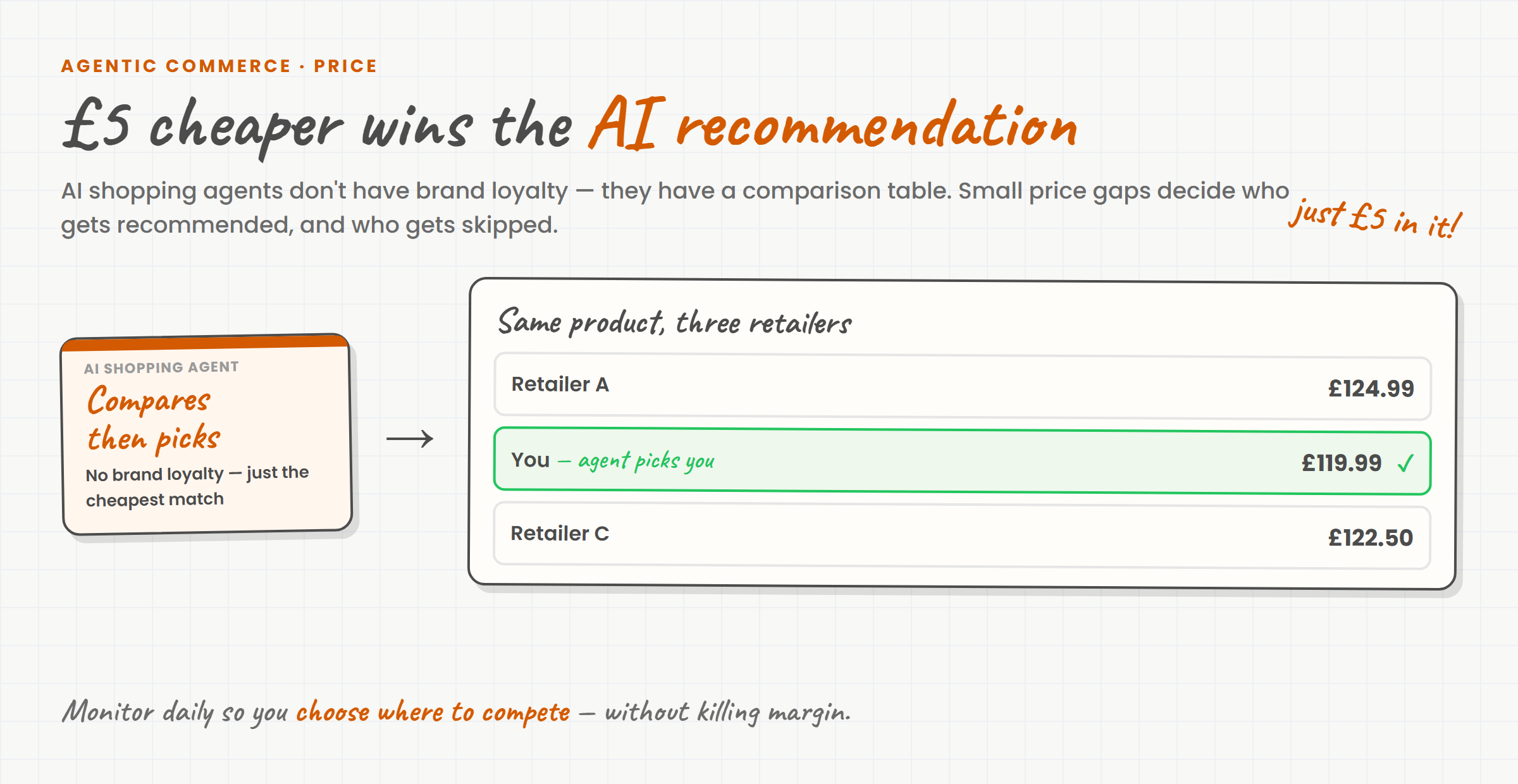
AI shopping agents don't have brand loyalty. They have a comparison table.
Here is what has actually changed. A traditional search results page handed the shopper a long list of retailers to scroll, compare and choose from. An AI shopping assistant does not. When a shopper asks Google's AI to find a product, a cordless lawnmower, a bathroom tap, a pair of running shoes, it compares prices, availability, reviews and product data across the market and then recommends a small number of retailers, sometimes only two or three. Everyone else is not in the conversation at all.
The signals that decide which few retailers make that shortlist have changed dramatically. Ranking hard and bidding hard is no longer enough on its own. The AI weighs data quality, review scores, feed completeness and, for many categories, price competitiveness. That is a strategic shift, not a tactical one, and the old way of competing for visibility has largely passed. Winning a place on the shortlist now takes deliberate work on the signals the AI actually reads.
Price is one of the loudest of those signals. A gap between your price and a competitor's that you haven't noticed can be the difference between making the shortlist and being passed over entirely. This is not only a pricing problem, it is a visibility problem, and you cannot respond to a visibility gap you cannot see.
Why does price matter so much for AI shopping recommendations?
Google has confirmed that products appearing in its AI-driven shopping surfaces — AI Mode in Search, AI Overviews, the Gemini app — are assessed on a combination of signals: price competitiveness alongside data quality, review scores, and feed completeness. Google's own Merchant Centre pricing tools define a competitive benchmark as the price that "typically leads to more successful ad auctions, impressions, clicks, or conversions." Products priced meaningfully above that benchmark are flagged in Merchant Centre as having a pricing gap — and by Google's own framing, that gap has a direct bearing on performance.
Google's Universal Cart, which launched with select US merchants in mid-2026 and is confirmed for UK rollout later this year, makes this more direct still. As Google's own announcement describes it, the cart actively works "in the background — finding deals and price drops, giving you insights on price history." An AI monitoring a shopper's cart will surface a cheaper alternative when your competitor undercuts you. If your price doesn't move, theirs surfaces instead.
Price is no longer purely a conversion lever. In AI-mediated shopping, it is a discoverability lever. Being priced out of step with the market on a key SKU can mean your product does not appear in the recommendation at all — regardless of how strong your feed, reviews, or brand are.
Why daily monitoring beats a weekly spot-check
Most retailers who track competitor prices do it manually and infrequently — a check on a Monday morning, or a reaction when a competitor's sale appears on social media. In a traditional search environment, that was often workable. In an environment where AI tools actively track price history, it is not enough.
Three things improve with systematic daily monitoring:
You see patterns, not snapshots. A Monday check misses a Thursday-to-Sunday promotional cycle a competitor runs fortnightly. With daily data over several weeks, you can see when they promote, how deep the cut goes, and whether it is sustained or short-lived. That tells you whether to respond — or wait them out.
You can act before you have lost the sales. Price gaps on high-volume SKUs move through AI comparison systems quickly. Google's Merchant Centre compares your live feed prices against the competitive benchmark continuously. Daily monitoring that surfaces an undercut the same morning gives you the option to respond the same morning, not a week later when the damage is done.
You build an evidence base for real decisions. One month of daily data shows you which SKUs you are consistently above-market on, how individual competitors behave, and, when paired with your Google Ads conversion data, what a price change on a specific SKU actually does to sales volume. That is a pricing strategy grounded in live evidence. Deep category experience is worth a great deal, but experience and industry averages are not the same as data, and they are rarely tested against what the market is doing right now. Retail moves too quickly for rules of thumb to keep pace, and the retailers who stay ahead are the ones watching the actual numbers move, week by week, and acting before their competitors do.
How to monitor without racing to the bottom
Here is where retailers go wrong: they discover they are being undercut and drop prices across the board. That is not a strategy. It is margin erosion.
The purpose of monitoring is to give you information, not to dictate a response. Knowing where you are uncompetitive lets you make deliberate, SKU-level decisions:
- Hero SKUs (high search volume, price-elastic, customer acquisition lines): matching a small gap may be worthwhile if the alternative is being absent from AI recommendations on your most-searched products.
- High-margin niche lines: hold your price. If a competitor wants to sell thin, that is their problem.
- Lines where you have a structural advantage — faster dispatch, an exclusive variant, stronger aftercare: price is one signal among several. Improving your feed attributes and review count often matters more than closing a small price gap here.
This is a cost-of-sale (CoS) question. What is the margin cost of matching this price? Does the expected sales uplift justify it? You can only answer that if you know the competitor's price and can see how your current pricing is performing against it. For more on this kind of trade-off framing, our article on moving beyond ROAS to an efficiency framework covers the methodology.
Margin is not the goal. Profit is.
It is tempting to read all of this as a case for protecting margin, but that is only half the picture. The number that actually matters is total profit, not margin percentage. A price cut that halves your margin on a line can still be the right move if it wins enough extra volume to grow the total profit that line makes, as long as you can source the additional stock and your fulfilment can absorb the extra orders without new cost or delay.
That is the decision monitoring lets you make properly. Sometimes the data says hold your price and defend margin. Sometimes it says a competitor has opened a gap on a high-volume line, and matching it, or even going under, will more than pay for itself in units sold. Blindly cutting prices erodes profit, but blindly protecting margin quietly hands volume, and eventually visibility, to whoever is willing to price for it. Neither is a strategy. Profit-maximising pricing, decided SKU by SKU on live data, is.
This is why we treat pricing as a profit question rather than a margin one, and why the monitoring has to sit alongside your real sales and cost data. The point is not simply to see that a competitor is cheaper. It is to know whether closing the gap would make you money or cost you money once volume, supply and fulfilment are all in the frame.
What monitoring looks like in practice
A UK retailer selling home appliances uses daily monitoring across their top 40 SKUs. One morning, the dashboard shows two notable gaps.
SKU A — a bestselling cordless vacuum, listed at £129.
Three competitors sit consistently at £122–£125. The retailer is above Google's benchmark for this product. At £129, gross margin is approximately 42% (£54 per unit). Matching the midpoint at £124 reduces that to around 38% (£47 per unit) — a cost of £7 per unit sold.
The decision: if this SKU is shifting 25–30 units a month and above-benchmark pricing is suppressing visibility, the margin cost of matching (roughly £175–£210 per month) is small relative to the revenue at risk. Match, then measure sales impact over the next 30 days.
SKU B — a replacement filter accessory, listed at £45.
One discount retailer lists it at £37. But search volume is low, gross margin is above 60%, and there is no price-sensitivity signal in the conversion data. This competitor is isolated — it is not a trend. Decision: hold price. Do not give away £8 of margin to match a single discounter on a line where the data says price is not the deciding factor.
Without monitoring, both decisions are guesses. With it, they are calculated.
From the team
[Placeholder — add a short comment from Alistair, Ross, or Carrie before publishing. For example: an observation on how the agentic shopping shift is changing pricing conversations with clients, or a specific SKU-level situation (anonymised) that illustrates why daily data matters.]
Start with your top 20 SKUs by revenue
Rather than auditing your entire catalogue at once, begin with a competitive price check on your top 20 revenue-generating SKUs this week. Find out how your prices sit relative to the market, where the largest gaps are, and which competitors are systematically cheaper. That single exercise will tell you whether pricing is a visibility problem for your business — and on which of your most important lines.
Our Price Monitor service pulls competitor prices every morning, benchmarks them against your live Merchant feed, and surfaces the SKUs where you are most exposed — alongside your Google Ads conversion data so you can weigh the margin trade-off before deciding whether to act.
For more on what it takes to be found in AI-led search, read our guide to Google AI Mode 2026 and what the shift means for UK eCommerce. And for the other side of AI readiness, our article on product reviews and FAQ schema for AI recommendations covers the feed and content signals that work alongside price.