
Google's Universal Cart: what it means, what it doesn't, and the stay-or-go question every UK retailer faces
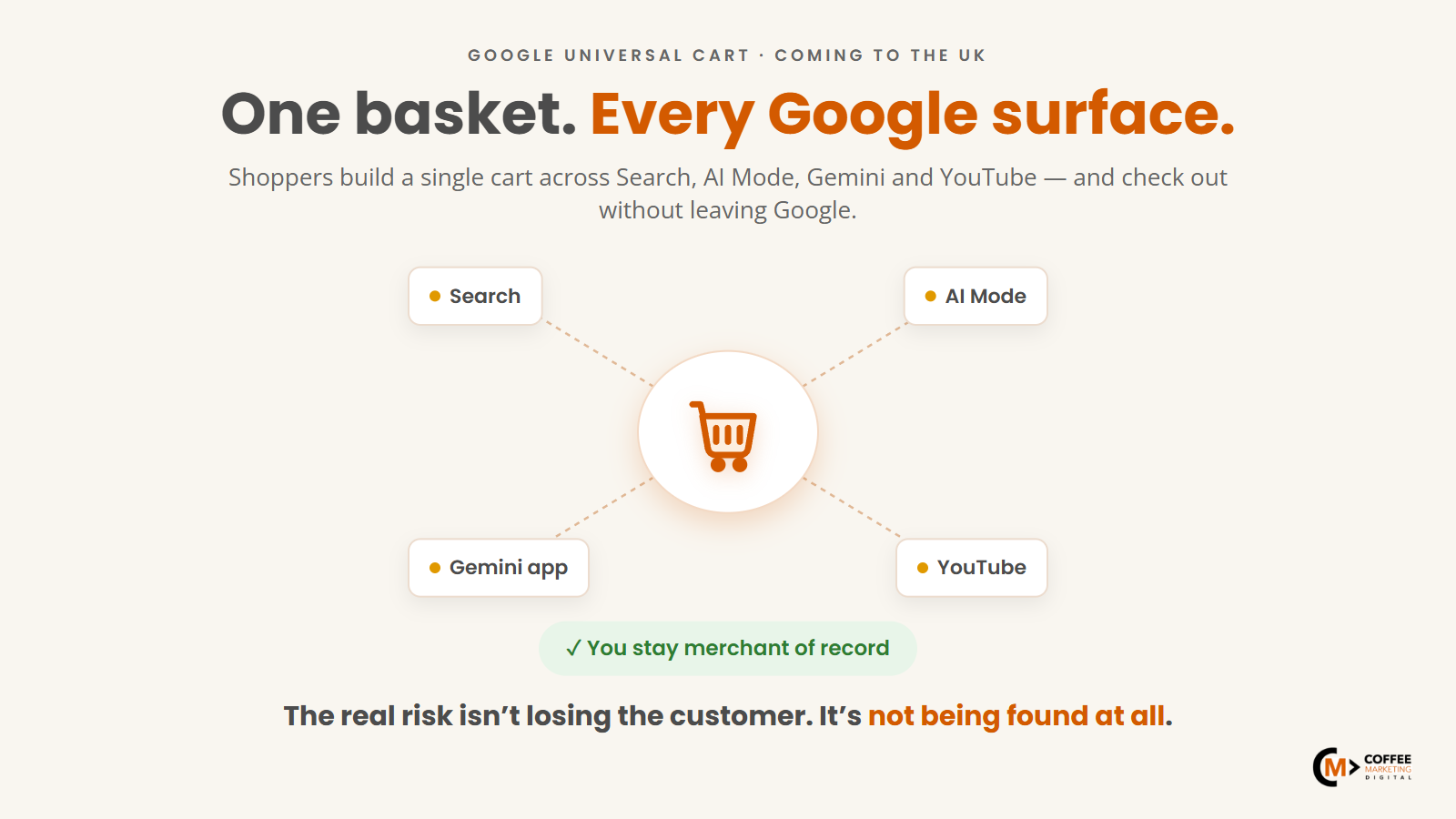
The loudest concern we've heard from UK retailers about Google's Universal Cart isn't legal, or technical, or commercial. It's visceral: "I'm not handing Google my customer."
That instinct is reasonable. Google is the biggest player in online retail discovery. The idea of them owning the checkout moment — the exact point where a stranger becomes your customer — feels like the last thing you'd want to agree to. One client told us plainly: they don't want to be in it.
But the instinct is based on a misconception. And clearing up that misconception changes the entire decision. This is part of the wider Google AI search shift every UK retailer now needs a position on.
What Universal Cart actually is
Universal Cart is a shared shopping basket powered by Gemini — Google's AI — that follows a shopper across Google's surfaces: Search, AI Mode, the Gemini app, YouTube, Gmail. Instead of each retailer having a separate basket, there's one persistent cart that accumulates items from multiple brands as the shopper browses.
While items sit in that cart, Gemini works in the background. It flags price drops, sends back-in-stock alerts, surfaces loyalty perks, and runs compatibility checks — showing a warning, for example, if a component doesn't fit another item already in the cart.
The shopper then has two ways to buy:
- Google Pay in-cart — a few taps, purchase complete, without leaving Google's surface.
- Merchant handoff — items transfer to the retailer's own checkout to complete the purchase.
The retailer connects their catalogue, stock and checkout via a standard called the Universal Commerce Protocol (UCP) — a set of APIs that links your product data and checkout flow to Google's AI surfaces. It's the plumbing that lets AI Mode, the Gemini app and Universal Cart read and sell your products.
This is not live in the UK yet. It launched in the US in summer 2026, with Canada and Australia following in "the coming months." The UK is explicitly named as next — but there is no firm date. That gap is exactly why now is the right time to think about it.
The misconception: what "giving Google the customer" actually means
Here's the fact that reframes the whole conversation, verified directly from Google's own announcement blog: "No matter which way you buy, the brand stays the merchant of record."
Merchant of Record means you are the legal seller. The transaction, the VAT, the returns, the customer relationship — those are yours. Google Pay in-cart is a checkout convenience, the same way Apple Pay or Shop Pay is a checkout convenience. It doesn't transfer customer ownership. The retailer retains full control of customer data and the customer relationship either way.
So the fear — "I'm handing Google my customer" — is not what's on offer. What's on offer is a simpler question: does your product appear in Google's AI-driven shopping surface, or not?
The real trade-off
This is where the decision actually sits.
Agentic shopping is what happens when an AI does the product research, comparison and purchase on behalf of a shopper. A shopper tells Google's Gemini Spark: "find me a cordless lawnmower under £250, next-day delivery, good reviews." Spark searches, compares, picks, buys. The shopper never visits a retailer's website.
That's not a distant future. Google announced Gemini Spark at Google I/O 2026 and is rolling it out in the US now, with a UK arrival expected within twelve months.
For agentic shopping to work, Google needs your products in the system. Products that haven't connected via UCP are simply not findable through that surface.
Google made this explicit in a GML 2026 Q&A session on UCP opt-outs, as reported by the Coffee Marketing team:
"If you don't want to give Google the means to be able to show you and find you, they're not going to find you and show you."
— Google, GML 2026 Q&A on UCP opt-out
Opting out doesn't protect your customer relationship. You keep that either way. What opting out costs you is being found.
The launch picture
Universal Cart launched in the US in summer 2026. Confirmed partners include Nike, Sephora, Target, Ulta Beauty, Walmart, Wayfair, and Shopify merchants — with Fenty and Steve Madden named specifically from the Shopify side.
Shopify is worth noting because it's a named supported platform for UCP integration. If you're on Shopify, the technical lift to connect is lower than building a custom API integration from scratch.
| Region | Status |
|---|---|
| United States (Search + Gemini app) | Live, summer 2026 |
| Canada + Australia | "Coming months" — not yet live as of 22/06/2026 |
| UK | "Later" — no firm date |
| YouTube + Gmail (US) | After Search/Gemini — no date confirmed |
Canada and Australia going live will be the first real-world signal on the UK mechanics — including what the opt-in process looks like and how the Embedded Checkout option (an iframe for retailers who want their own branding at checkout) works in practice. We'll be watching those markets closely.
Who should lean in, who can wait
The decision isn't binary. The right answer is almost always: prepare now, decide at UK launch.
Lean towards joining when:
- Your products are discovery- and comparison-driven — shoppers research before they buy
- You have a broad catalogue with strong feed data quality
- You're already doing Conversational Attributes and schema work
- You're on Shopify (lowest integration lift of any platform named so far)
- Discoverability in AI Mode and Gemini is a meaningful part of your growth plan
Take more time when:
- Your checkout involves complex custom flows, B2B account-level pricing, or trade terms
- You monetise heavily through the post-purchase relationship and want to review what Embedded Checkout actually looks like before committing
- Your product feed isn't clean yet — joining UCP without solid data quality is wasted effort
Neither group needs to decide anything today. What both groups need to do is covered below.
The prep work is identical either way
The work that makes a retailer ready for Universal Cart is exactly the same work that improves AI Mode visibility right now, regardless of UCP.
Clean, complete product feed. Conversational Attributes populated. Product schema and reviews on your website. Lifestyle images alongside your primary. These aren't UCP-specific tasks — they're the foundation the AI reads from, whether you're in Universal Cart or not.
Retailers who get this work done now arrive at the UK UCP launch with a real head start. Retailers who wait until the launch announcement to start will be doing the groundwork under time pressure.
If you want to know exactly where your feed and AI readiness stand today, our AI Visibility Report gives you a documented answer across feed quality, schema, and Conversational Attributes coverage — and the order to fix them in.
One thing to do this week
Check whether your platform is UCP-capable.
For Shopify merchants: UCP integration is already on the Shopify roadmap. Ask your developer or agency whether your current setup supports it, and register interest with Google via their UCP support contact form — merchants join via a waitlist.
For non-Shopify retailers: establish whether your platform supports REST API integration, and flag UCP for your next technical roadmap review. The UK launch timeline is uncertain, but the onboarding window when it arrives won't be long. Retailers who've mapped the integration in advance will be first through the door.
The feed and schema work? Start that regardless. It's the highest-return task available for AI visibility right now — and it counts towards your Universal Cart readiness at the same time.